Watch how it’s made
Every step in 1:15 — from the ingredients to the finished dish.
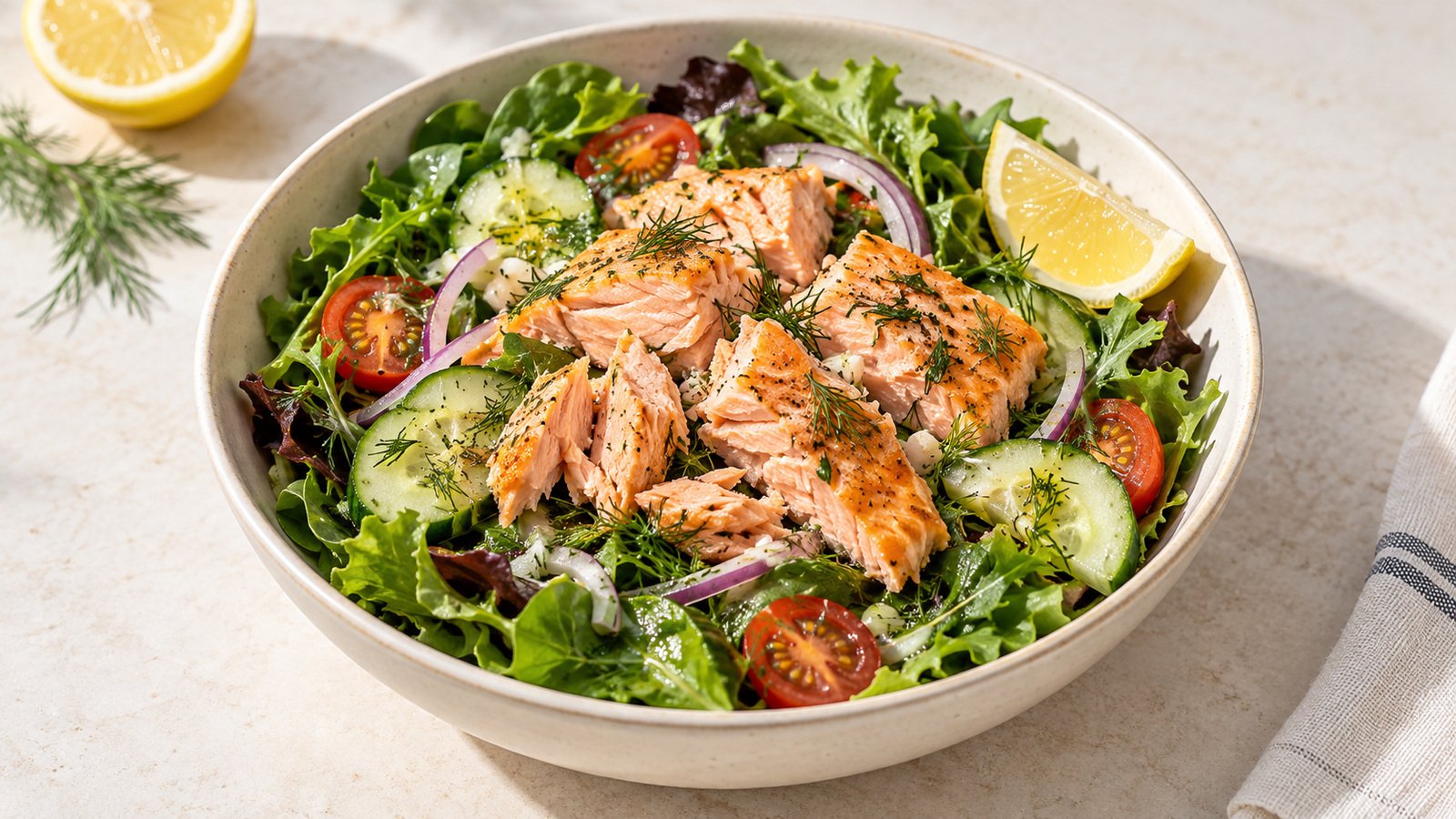
This is the lowest-carbohydrate lunch on the site: 7 grams per portion, almost all of it from the vegetables. It is built on canned salmon, which is cheaper than fresh, keeps in a cupboard for years, and carries the same omega-3 fats that make salmon worth eating in the first place.
Ten minutes, no cooking, and 32 grams of protein. It is the lunch to keep in mind for days when a larger carbohydrate portion at midday would be inconvenient.
Canned salmon deserves more respect
Canned salmon is usually wild-caught pink or sockeye, and it is one of the few convenience foods that is genuinely as good as its fresh equivalent nutritionally. It carries the long-chain omega-3 fats, EPA and DHA, that are associated with lower triglycerides.
Buy it with the bones in if you can. They are soft, they crush into the mix without anyone noticing, and they are a substantial source of calcium that the boneless version simply does not have.
Greek yogurt instead of mayonnaise
Half a cup of mayonnaise carries around 80 grams of fat. The same volume of plain Greek yogurt carries under 2, along with 12 grams of protein.
Yogurt alone can taste thin against fish, which is why there is a spoonful of Dijon here. Mustard brings the sharpness that mayonnaise would otherwise provide, at no meaningful carbohydrate cost.
Dill is not a garnish here
Dill and salmon is a pairing that survives because it works: the herb cuts through the oiliness of the fish in a way parsley does not. Use considerably more than looks sensible.
Fresh is much better than dried for this. Dried dill loses most of its character, and in a cold dish there is no heat to draw it out.
What to eat it with
At 7 grams of carbohydrate, this leaves you room. Spooned into lettuce cups it stays very low; on a slice of whole grain bread it adds around 15 grams; with a small serving of whole grain crackers, somewhere between.
That flexibility is the practical value of a low-carbohydrate base. You decide how much carbohydrate the meal carries rather than the recipe deciding for you.
Three days, and a warning about celery
The mixture keeps three days refrigerated and the flavor improves after a few hours as the dill and lemon work through.
Add the celery on the day you eat it if you can. It softens noticeably by day two, and the crunch against the soft salmon is much of what makes the dish work.