Watch how it’s made
Every step in 1:10 — from the ingredients to the finished dish.
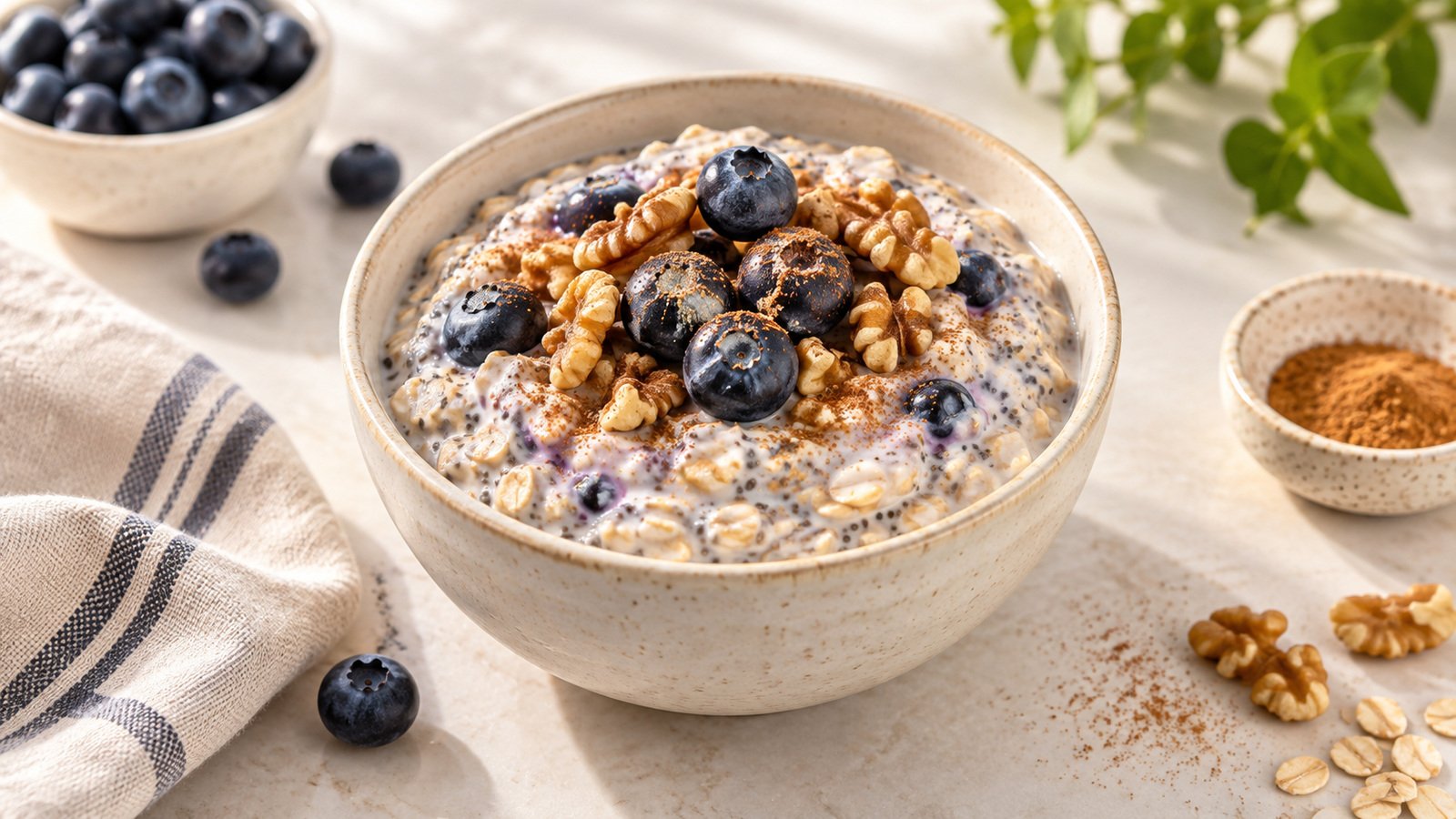
Overnight oats have a reputation problem in diabetes circles, and it is half deserved. The versions that circulate most widely are a full cup of oats, sweetened yogurt and a mountain of granola, and they land near 60 grams of carbohydrate before you have added anything at all. This one is built the other way round: half a cup of oats rather than a full cup, Greek yogurt doing most of the work, and chia seeds carrying the texture. It comes out at 34 grams of carbohydrate with 9 grams of fiber and 20 grams of protein per jar.
The point is not that oats are a problem. It is that oats alone, in the quantity most recipes use, are a large carbohydrate load first thing in the morning, which is when many people with diabetes are least insulin sensitive.
Why the morning is the hardest meal
Blood glucose tends to run higher in the early hours for reasons that have nothing to do with what you eat. The dawn phenomenon, a normal rise in cortisol and growth hormone before waking, leaves many people with diabetes more insulin resistant at breakfast than at any other point in the day. The same bowl that behaves reasonably at three in the afternoon can produce a noticeably higher rise at seven in the morning.
That is why a breakfast built around protein and fiber, with carbohydrate present but not dominant, is often easier to manage than a larger carbohydrate portion eaten on its own. None of this is a rule. It is a pattern worth testing against your own meter.
What the protein is doing
Twenty grams of protein per jar comes almost entirely from the Greek yogurt, and it is the single change that separates this from a standard overnight oats. Protein slows gastric emptying, which flattens the curve rather than removing it, and it is also why a jar this size keeps most people going until lunch instead of leaving them hunting for a mid-morning snack.
Use plain Greek yogurt, not flavored. Flavored pots commonly carry 12 to 20 grams of added sugar each, which would undo the arithmetic entirely and quietly turn this into a dessert.
Chia seeds and the texture problem
Overnight oats made with less oats can end up thin. Chia seeds solve this: each seed absorbs several times its weight in liquid and sets the mixture into something spoonable rather than soupy. Two tablespoons also contribute 8 grams of fiber across the two jars, most of it soluble.
They need time. Four hours will do at a push, but the texture is noticeably better after a full night, and the difference is about mouthfeel rather than anything else.
Blueberries, and why whole fruit is fine
Whole fruit is not the same proposition as fruit juice. The 16 grams of carbohydrate the blueberries contribute arrive alongside fiber and inside intact cell walls, which slows their absorption considerably compared with the same sugars drunk from a glass.
Frozen blueberries work and are usually cheaper. Stir them in frozen and they thaw overnight, releasing a little color into the oats, which some people like and some do not.
Making it a week of breakfasts
The recipe is written for two jars because two is what fits comfortably in most refrigerators alongside everything else. It scales cleanly to four or five, and the mixture holds for four days refrigerated. Beyond that the oats soften past the point most people enjoy.
Add the almond butter at the start rather than on top. Stirred through it distributes evenly; spooned on at the end it sits in a lump and the last mouthful is all of it at once.