If you have recently been diagnosed with diabetes, or you are helping someone who has, carbohydrates are probably the first thing anyone told you to pay attention to. There is a good reason for that. Of the three macronutrients, carbohydrate has by far the largest and fastest effect on blood glucose. What often gets lost in the advice, though, is that carbohydrate is not a single thing to be avoided. It is a broad category that includes table sugar and lentils, white bread and broccoli, and those foods behave very differently once you have eaten them.
What are carbohydrates?
Carbohydrates are one of the three main macronutrients that give your body energy, alongside protein and fat. They are found in a wide range of foods: grains, fruit, vegetables, legumes, dairy products and anything containing added sugar. In chemical terms they are chains of sugar molecules, and the length and structure of those chains is what determines how quickly your body can break them down.
Your digestive system converts most carbohydrate into glucose, which passes into the bloodstream and becomes the primary fuel for your cells. This is a normal and necessary process. Your brain alone uses roughly 120 grams of glucose a day, and carbohydrate is where most of it comes from. The issue in diabetes is not that glucose enters the blood, but that the mechanism for moving it out of the blood and into the cells no longer works as it should.
How do they affect blood sugar?
In a body without diabetes, rising blood glucose triggers the pancreas to release insulin, which acts as a key allowing glucose into cells. In type 1 diabetes, the pancreas produces little or no insulin. In type 2 diabetes, the pancreas usually still produces insulin, but the cells respond to it poorly, a condition called insulin resistance, and over time the pancreas may struggle to keep up with demand. Either way, glucose accumulates in the bloodstream rather than being used.
This is why the amount and type of carbohydrate you eat matters so much. A meal built around refined carbohydrate delivers a large amount of glucose into the blood over a short window, which requires a correspondingly large insulin response. A meal built around fiber-rich carbohydrate eaten alongside protein and fat delivers the same glucose more slowly, spread across a longer period, which is far easier for the body to manage.
Types of carbohydrates
Nutrition labels group carbohydrate into sugars, starches and fiber, but the practical distinction is between simple carbohydrates, which are digested quickly, and complex ones, which are not. Fiber is a special case: it is technically a carbohydrate but passes through the digestive system largely intact, contributing no glucose and actively slowing the absorption of everything eaten alongside it.
| Type | Description | Examples | Effect on blood sugar |
|---|---|---|---|
| Simple | Natural or added sugars, digested quickly. | Sugar, honey, candy, juice, soda. | High |
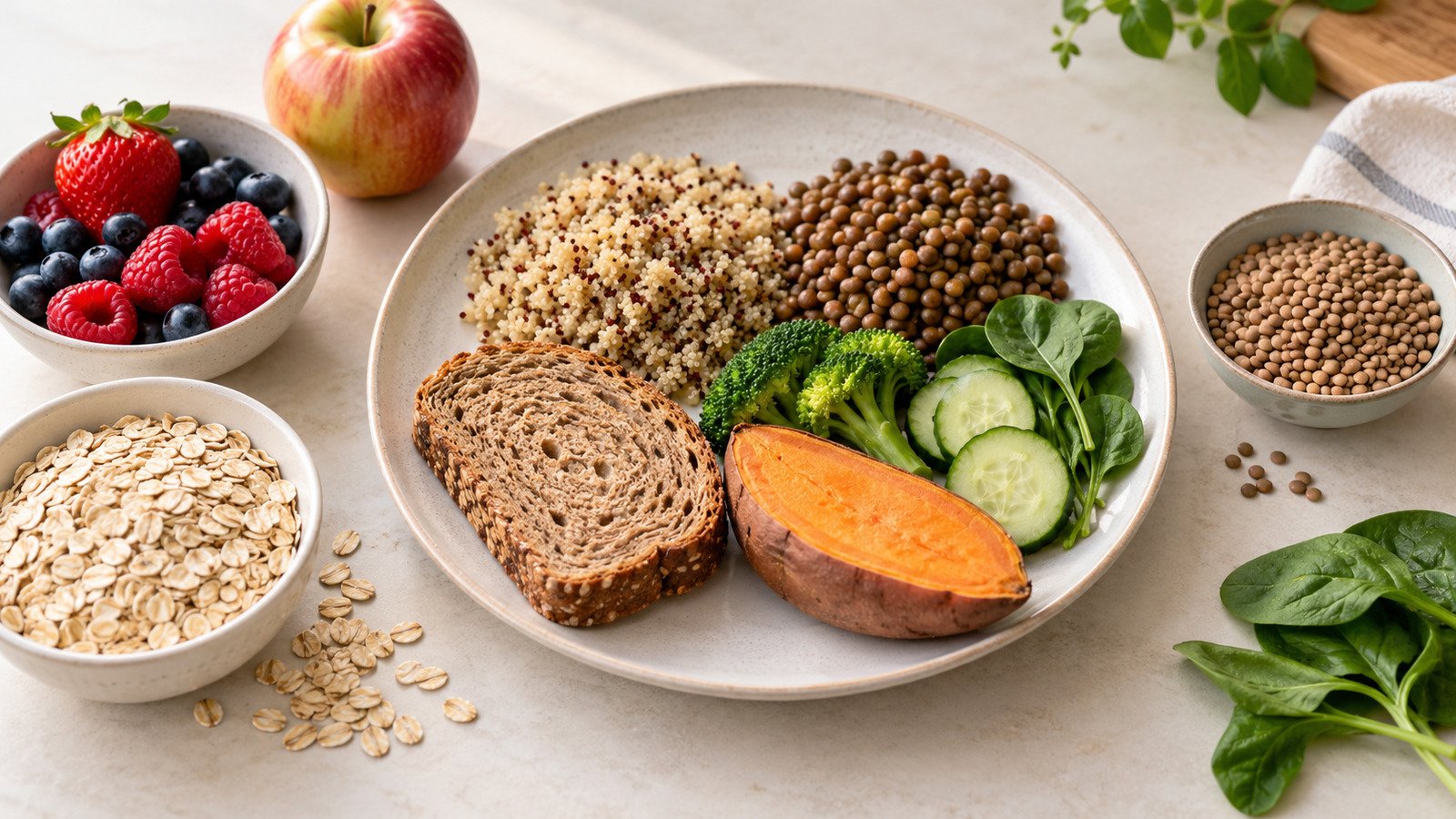
| Complex | Starches and fiber, digested more slowly. | Oats, quinoa, sweet potato, legumes, fruit. | Moderate |
| Fiber | Not digested, helps regulate blood sugar. | Vegetables, fruit, legumes, whole grains. | Low |
The glycemic index and its limits
The glycemic index, or GI, ranks carbohydrate-containing foods from 0 to 100 according to how quickly they raise blood glucose compared with pure glucose. Below 55 is considered low, 56 to 69 is medium, and 70 or above is high. Lentils sit around 30, oatmeal around 55, white rice around 73 and white bread around 75.
It is a genuinely useful concept, but it has limits worth knowing. The GI of a food is measured in isolation, on an empty stomach, in a standardised 50-gram carbohydrate portion. Almost nobody eats that way. Adding fat, protein or acid to a meal lowers its practical glycemic effect, as does eating vegetables before the starch. Ripeness changes it, cooking time changes it, and cooling a cooked starch such as potato or rice changes it too, because some of the starch recrystallises into a form the body digests more slowly.
Glycemic load is often the more useful number, because it accounts for portion size as well as speed. Watermelon has a high glycemic index but so little carbohydrate per slice that its glycemic load is low. Treat GI as a rough guide for comparing similar foods, not as a rule that overrides everything else on the plate.
How to choose better options
Most of the practical benefit comes from a handful of habits rather than from memorising numbers. The aim is to slow down the arrival of glucose, and every one of the points below does that in a slightly different way.
- Choose whole grains instead of refined grains.
- Include fiber with every meal.
- Pair carbohydrates with protein and healthy fats.
- Watch portion sizes to keep levels steady.
- Eat vegetables and protein before the starch at a meal, which measurably reduces the peak that follows.
- Prefer whole fruit over juice, since juicing removes the fiber that slows absorption.
- Keep your carbohydrate intake reasonably consistent from day to day, which makes it far easier to see what is actually affecting your readings.
Reading the numbers on a label
On a nutrition label, total carbohydrate is the figure that matters most, and it already includes both the sugars and the fiber listed beneath it. Some people subtract fiber from total carbohydrate to calculate net carbs, an approach that has a reasonable basis, since fiber genuinely does not raise blood glucose. It is worth asking your dietitian whether counting net carbs or total carbs suits your situation, because the answer differs depending on your medication and how you dose it.
Be aware that sugar alcohols such as maltitol, sorbitol and xylitol are counted within total carbohydrate on most labels and do affect blood glucose, though less than sugar does. Products marketed as sugar-free frequently rely on them, which is why a sugar-free biscuit is not the free food it appears to be.
Example foods and their impact
| Food | Serving | Carbohydrates (g) | Glycemic index |
|---|---|---|---|
| Oatmeal | 1/2 cup cooked | 27 | Low (55) |
| White rice | 1/2 cup cooked | 45 | High (73) |
| Lentils | 1/2 cup cooked | 20 | Low (30) |
| White bread | 1 slice | 15 | High (75) |
| Apple | 1 medium | 25 | Low (38) |
How much carbohydrate should you eat?
There is no single correct answer, and anyone who gives you one without knowing your circumstances is guessing. Diabetes organisations generally describe a starting point of roughly 45 to 60 grams per meal for many adults, with 15 to 20 grams for a snack, but the right target for you depends on your body, your activity level, your medication and what your own glucose readings show. Someone using rapid-acting insulin at mealtimes has a different relationship with carbohydrate than someone managing type 2 diabetes with diet and metformin.
The most reliable way to find your own answer is to combine a target from your care team with your own measurements. Checking your glucose before a meal and again about two hours afterwards tells you, over a few weeks, which meals your body handles comfortably and which ones it does not. That personal data is worth more than any general guideline, and it frequently produces surprises: two foods with similar labels can affect two people quite differently.
This guide is educational and is not a substitute for individual medical advice. Any change to how you eat should be discussed with your doctor or a registered dietitian, particularly if you take insulin or medication that can cause low blood sugar.