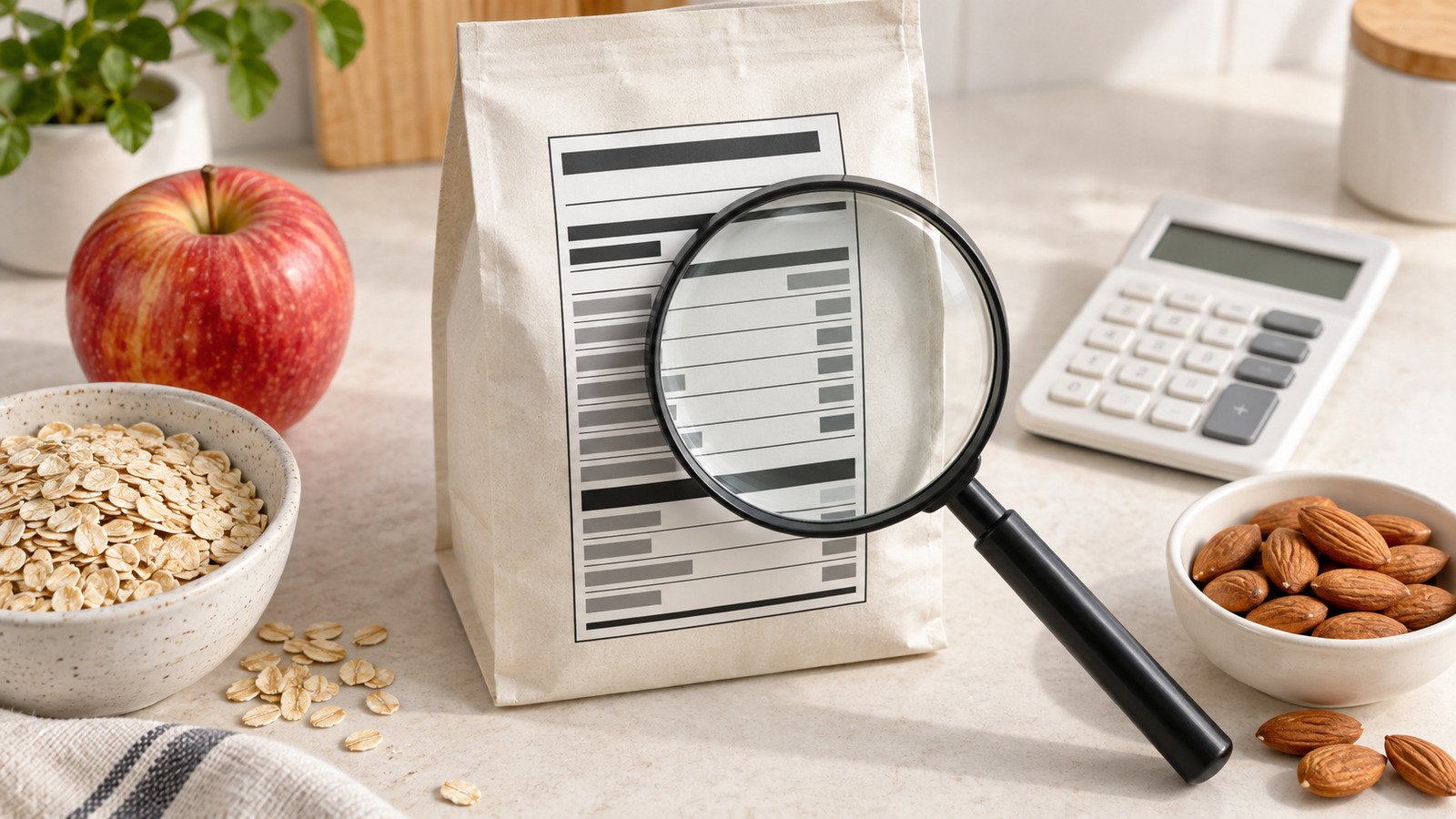
The front of a food package is marketing. The back is information. Learning to skip the first and read the second is probably the single most useful practical skill for managing diabetes in a supermarket, and it takes about twenty seconds per product once you know what you are looking for.
Why nutrition labels matter
Understanding food labels is one of the most useful skills for managing diabetes. Labels tell you exactly what is in a food, which lets you track carbohydrates, spot hidden sugars, and make informed choices about what you eat every day. They also let you compare two similar products directly, which is where most of the practical benefit comes from: the difference between two brands of the same thing is often larger than you would expect.
Key things to check
Serving size
Always start here. Every other number on the label is based on one serving. Many packages hold several servings, so eating the whole package means multiplying every value by the number of servings it contains.
This is the most common source of accidental error, and manufacturers are not always working in your interest when they set it. A bottle of drink that looks like one portion is frequently labelled as two and a half. A small bag of crisps may be listed as two servings. Before reading anything else, check the serving size and ask yourself honestly how much of the package you are likely to eat.
Total carbohydrates
This figure includes sugars, fiber and starches, and for diabetes management it is the most important number on the label. Aim for a consistent carbohydrate intake at each meal, typically 30 to 45 grams depending on your plan.
Note that total carbohydrate already includes everything listed beneath it. You do not add the sugars to the total, they are part of it. This trips up almost everyone at first.
Added sugars
Look for added sugars specifically. Natural sugars from fruit or dairy behave differently from sugar added during processing, mainly because they arrive alongside fiber, protein or fat. Try to choose foods with less than 5 grams of added sugars per serving where you reasonably can.
The added sugars line is a relatively recent addition to labels in many countries and it is genuinely useful, because it separates the naturally occurring lactose in a yogurt from the sugar someone stirred into it.
Fiber
More fiber is better. Fiber slows digestion and helps blunt blood sugar spikes. Look for at least 3 grams per serving in any grain product, and treat 5 grams or more as good. For a bread or cereal, the ratio of total carbohydrate to fiber is a quick quality test: under 10 to 1 is a reasonable threshold.
Sodium
Under 140mg per serving counts as low sodium. This matters for blood pressure, which often needs managing alongside diabetes. Tinned soups, sauces, bread and processed meats are the usual sources, and the amounts are frequently much higher than people expect.
Fats
Look at the breakdown rather than the total. Unsaturated fats from olive oil, nuts, seeds and fish are associated with better cardiovascular outcomes. Saturated fat is worth limiting, and any product still listing partially hydrogenated oil in its ingredients should go back on the shelf.
The ingredient list is where the truth is
Ingredients are listed in descending order by weight, so whatever appears first is what there is most of. If sugar, in any of its names, appears in the first three ingredients, that tells you more than any front-of-package claim.
Sugar travels under a great many names, and manufacturers can split it across several so that none of them reaches the top of the list. Watch for sucrose, dextrose, maltose, fructose, high fructose corn syrup, corn syrup solids, cane juice, evaporated cane sugar, agave nectar, honey, molasses, malt syrup, rice syrup and fruit juice concentrate. They are all sugar.
What to look for at a glance
- Check the ingredient list for hidden sugar names: dextrose, maltose, corn syrup, agave, cane juice.
- Compare similar products and choose the one with fewer carbs and more fiber.
- Do not be swayed by front-of-package claims like ‘sugar-free’ — check total carbohydrates instead.
- Ingredients are listed by weight, so whatever comes first is what there is most of.
- Multiply everything by the number of servings you will actually eat.
- Watch for sugar alcohols such as maltitol, which do raise blood glucose despite appearing in sugar-free products.
- Use a food tracking app to log what you actually eat.
Front-of-package claims and what they really mean
Most claims on the front of a package are legally defined but narrower than they sound. Sugar-free means less than 0.5 grams of sugar per serving, which says nothing about starch. No added sugar means none was added during processing, which says nothing about how much fruit concentrate is in there. Light or lite may refer to fat, calories or even colour, and reduced-fat products frequently compensate with added sugar to restore the flavour.
Products marketed as suitable for diabetics deserve particular scepticism. They are often expensive, frequently rely on sugar alcohols that cause digestive upset in quantity, and rarely offer anything a carefully chosen ordinary product does not.
Daily value reference
| Nutrient | Daily value | Note for people with diabetes |
|---|---|---|
| Carbohydrates | 45-60g per meal | Adjust to your medical guidance |
| Fiber | 25-30g per day | More fiber = better glucose control |
| Added sugars | < 25g per day | The less, the better |
| Sodium | < 2,300mg per day | Important for blood pressure |
| Saturated fat | < 13g per day | Prefer unsaturated fats |
These are general reference figures for adults, not personal targets. A dietitian can translate them into numbers that fit your body, your medication and your daily routine.