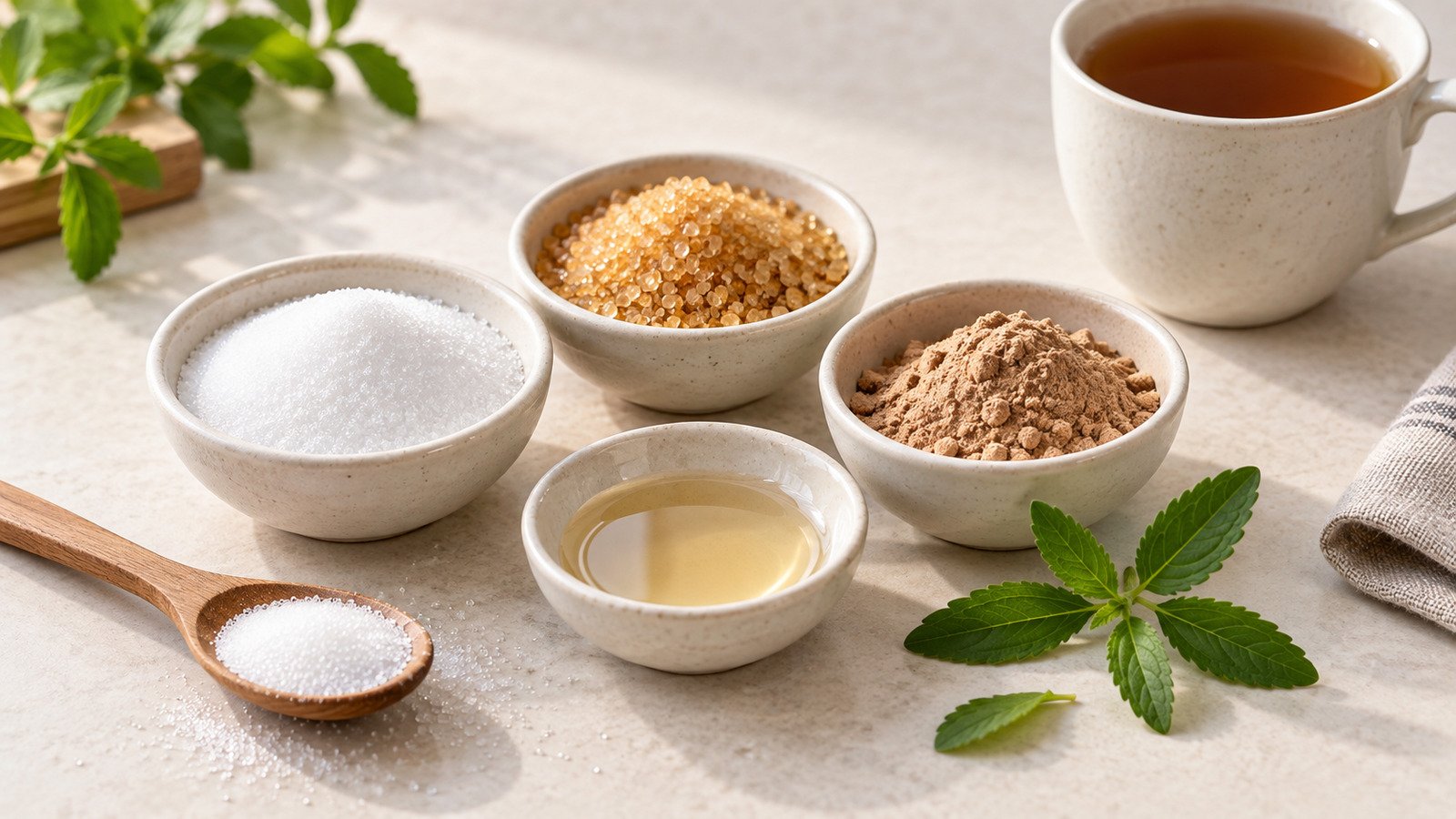
Sweeteners occupy an odd place in diabetes advice. They are simultaneously presented as an obvious solution and as something faintly suspicious. The reality is more ordinary than either: the approved sweeteners have a substantial safety record, they genuinely do not raise blood glucose the way sugar does, and they are a useful tool rather than a health food.
What are sweeteners?
Sweeteners provide a sweet taste without significantly raising blood sugar. There are natural and artificial options, and a third group, the sugar alcohols, that sits somewhere between the two. Each has its own advantages and considerations, and they behave differently in cooking as well as in the body.
Types of safe sweeteners
| Sweetener | Type | Calories | Glycemic index |
|---|---|---|---|
| Stevia | Natural | 0 | 0 |
| Erythritol | Natural | 0.2/g | 0 |
| Sucralose | Artificial | 0 | 0 |
| Monk fruit | Natural | 0 | 0 |
Stevia
Extracted from the leaves of the stevia plant, it is 200 to 300 times sweeter than sugar and contributes no carbohydrate. It is heat-stable, so it works in baking, though it provides none of the bulk, browning or texture that sugar does. Some people detect a liquorice-like aftertaste, which varies by brand and by the specific steviol glycosides used.
Monk fruit
Also called luo han guo, monk fruit extract is similarly intense and carbohydrate-free, with a cleaner aftertaste than stevia for most people. It is usually more expensive and is frequently sold blended with erythritol to give it bulk.
Erythritol and the other sugar alcohols
Erythritol is the sugar alcohol that behaves best: it is absorbed and excreted largely unchanged, has essentially no effect on blood glucose, and causes less digestive upset than its relatives. Its cousins are a different matter. Maltitol, sorbitol and xylitol all raise blood glucose to varying degrees, and all can cause bloating, wind and laxative effects in quantity. Maltitol in particular is common in products labelled sugar-free and has roughly half the glycemic impact of sugar, which is a long way from none.
Xylitol carries a specific warning worth repeating: it is highly toxic to dogs, even in small amounts. Keep any product containing it well away from pets.
Aspartame, sucralose and acesulfame K
These are the long-established artificial sweeteners, approved by regulators including the FDA and EFSA and used for decades. They contribute no carbohydrate and no meaningful calories. Aspartame is not suitable for people with phenylketonuria, a rare inherited condition, which is why products containing it carry a specific warning. Sucralose is heat-stable and works in baking; aspartame is not and loses sweetness when heated.
Tips for using them
- Start with small amounts to get used to the taste.
- Read labels: some ‘sugar-free’ products contain maltitol, which does raise glucose.
- Stevia and monk fruit are the most natural options.
- Avoid aspartame if you have phenylketonuria.
- Remember that sweeteners replace the sugar, not the flour, in a baked product that still contains carbohydrate.
- Keep xylitol products away from dogs, for whom they are toxic.
The sugar-free product trap
The most common mistake is treating a sugar-free label as permission. A sugar-free biscuit is still made of flour and fat. A sugar-free chocolate bar sweetened with maltitol may raise your blood glucose almost as much as the ordinary version while also upsetting your stomach. The only reliable move is to turn the package over and read the total carbohydrate figure.
The same applies at home. Substituting stevia for sugar in a cake removes the sugar but leaves the flour, and the result is still a substantial source of carbohydrate. Sweeteners help most in things that are otherwise carbohydrate-free: coffee, tea, plain yogurt, chia pudding, whipped cream.
What about the recent debate?
You may have seen headlines questioning non-sugar sweeteners, including a 2023 World Health Organization guideline advising against using them for weight control, and separate research examining possible effects on the gut microbiome and cardiovascular risk. It is worth reading these carefully rather than dismissing or over-interpreting them.
The WHO guidance concerned long-term weight management in the general population, was described by the organisation itself as a conditional recommendation based on low-certainty evidence, and explicitly did not apply to people with existing diabetes. Major diabetes organisations continue to regard approved sweeteners as a reasonable way to reduce sugar intake. The sensible reading is that sweeteners are a useful substitution when they replace sugar, and not a health intervention in their own right. Water is still the better default drink.
If you have questions about a specific sweetener and your own medication or conditions, your doctor or dietitian is the right person to ask.